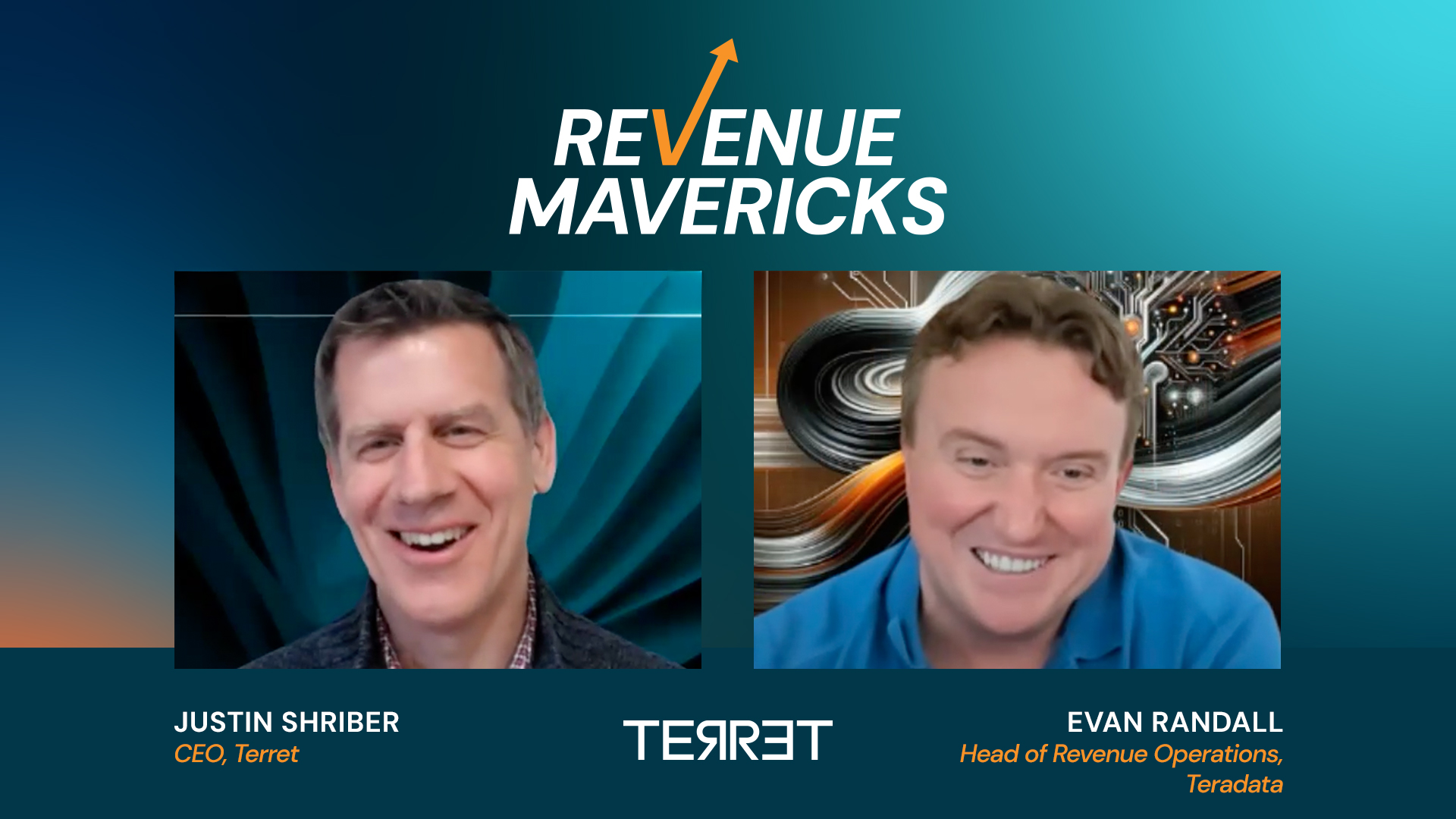

On this episode of Revenue Mavericks, I sat down with Evan Randall, SVP of Worldwide Revenue Strategy & Operations at Teradata. He told me about evenings at his kitchen table as a kid, watching his father unpack the day's challenges.
No laptop. No cell phone. Just a briefcase and stories about business problems that needed solving.
His dad would walk through what happened: who he talked to, what went wrong, how he thought through it. Evan was young, but he listened. And more importantly, he learned.
His father was a Vietnam War veteran who'd served two tours before attending Harvard Business School. At 21, he commanded 150 to 200 soldiers on a forward artillery base in a war zone, making life and death decisions in a place surrounded by minefields with no escape route except by helicopter.
After that? Nothing at work ever rattled him.
Evan internalized that lesson early. And it's shaped his entire career: "It's not as bad as being in Vietnam. It's just work."
That perspective has made Evan one of the most composed revenue operations leaders I know. Always calm, always optimistic, always moving forward. And when I asked him what drives exceptional results in his role at Teradata, his answer surprised me:
It's not about solving every problem. It's about knowing which ones to ignore.
1. Mastering Prioritization at Scale
Evan's defining moment came at Tableau Software more than a decade ago.
He joined as the company's first sales operations hire: $100 million in revenue, roughly 400 employees. Within four years, his team expanded to nearly 100 people as the company rocketed to just under $900 million.
The pace was unrelenting. They onboarded 50 new sales reps every four to five weeks. New managers were training reps who'd only been around two weeks longer than they had. Every decision mattered because small missteps meant tens of millions in lost opportunity or wasted spend.
That's where Evan discovered something most operators struggle to accept: you cannot fix everything.
Years ago, he heard a podcast episode about letting fires burn. The premise was simple but radical. In hypergrowth environments, there are always more problems than solutions. If you chase every issue, you dilute your impact to the point of irrelevance.
The real skill? Identifying which fires will destroy the business and which ones can burn without consequence.
"If you can attack these three fires and get your team behind that, you're going to be far more successful than trying to fix 15 or 30 fires all at once," Evan said.
This philosophy connects to something he learned at Wharton's executive education program: understanding risk thresholds. When you know the boundaries of what could go wrong, you can make fast decisions with confidence.
Low-risk problems? Move quickly without overthinking. High-risk problems? Invest the detail and rigor they deserve.
This is disciplined prioritization, and it's one of the hardest skills for ambitious operators to master.
2. Trust Is Built Through Action, Not Alignment
Evan sees revenue operations as the central nervous system of a company. You interface with sales, marketing, customer success, finance, product: everyone depends on what you build.
That centrality makes relationships non-negotiable. But relationships aren't forged in planning meetings. They're earned through delivering wins before anyone asks.
When Evan arrived at Teradata, the CMO was frustrated. She had no visibility into return per lead. The data existed somewhere, but leads weren't being linked to opportunities in Salesforce, so there was no way to track it.
Evan made one simple change: linking leads to opportunities became mandatory. It wasn't complex. It didn't overload the sales team. But it gave the CMO the insight she'd been requesting for months.
Quick win. Credibility established. Trust earned.
"Being willing to give, give, give way more before you expect to get anything back; that's been critical in every role I've had," Evan told me.
He's not advocating for being a doormat. He's talking about building a track record of helping people succeed, which creates reciprocity when you need it most.
Evan often references The Speed of Trust by Franklin Covey as a guiding framework. Build credibility through integrity, intent, capability, and results. Do that consistently, and you'll accomplish far more than the smartest person in the room ever could alone.
3. The RevOps Leader as the Future CRO
Toward the end of our conversation, Evan shifted gears.
He wanted to talk about something he'd been tracking: the evolving profile of the Chief Revenue Officer.
"PE and VC firms are increasingly looking at revenue operations and strategy leaders as the future CRO profile," he said. "And I think this is the Renaissance for our discipline."
Traditionally, when a CEO asks for a CRO, the first follow-up question is: "Who's the RevOps leader supporting them?" But Evan's seeing a shift in that logic. If the RevOps leader already owns strategic planning, systems architecture, operational rigor, and cross-functional alignment, why not give them the top job?
AI is accelerating this transformation. Sales is transitioning from art to science, and leaders who understand data, systems, and execution are the ones positioned to unlock exponential performance.
"If CROs remain that traditional closer-at-all-costs sales leader without expanding into strategic systems thinking and AI complexity, they're going to fall behind," Evan said.
He believes we're entering a new era for revenue operations. And honestly, the evidence supports him.
What This Means for RevOps Leaders
Evan's career isn't built on proprietary frameworks or complex methodologies. It's built on perspective, prioritization, and deliberate relationship building.
Let the small fires burn so you can focus on the ones that matter. Deliver quick wins to build trust before asking for support. And recognize that the next generation of CROs might look less like traditional sales leaders and more like strategic operators who know how to architect systems at scale.
The revenue operations leaders who internalize this will build organizations that move fast, make intelligent trade-offs, and scale without fracturing. The ones who don't will stay buried in tactical firefighting, wondering why their voice doesn't carry weight in the C-suite.
Listen to the full conversation here.